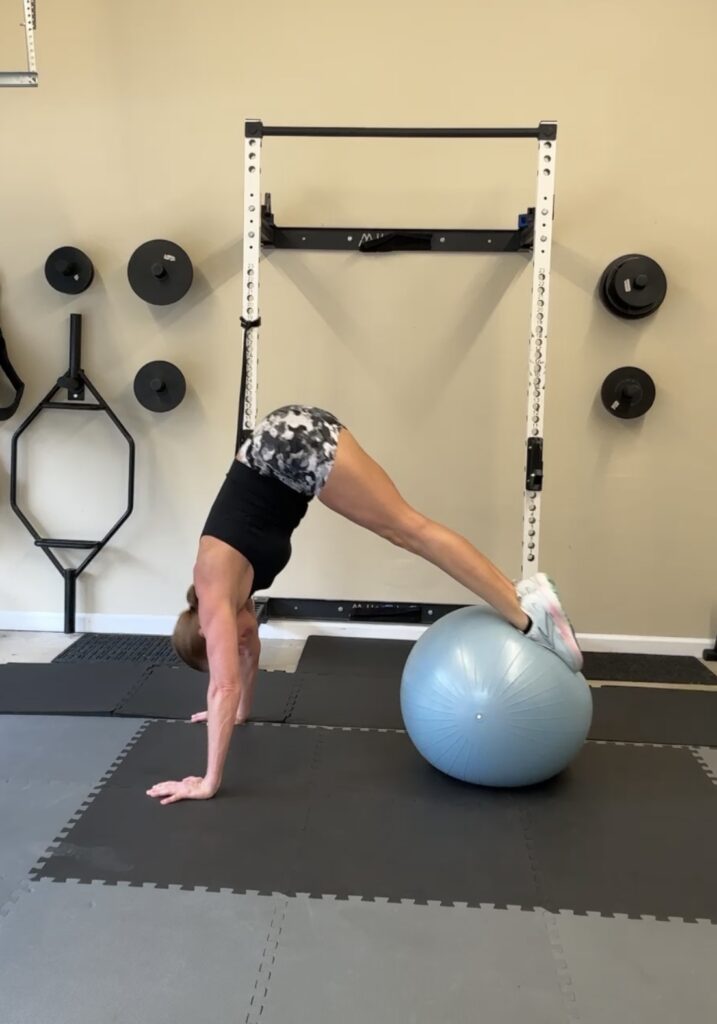
A Physical Therapist’s Guide to Building Core Strength, Stability & Control
Core training doesn’t have to mean hundreds of crunches or complicated gym equipment.
If you’re new to core training, the goal isn’t to jump into the hardest exercise you can find. The goal is to build control first, then gradually add movement, resistance and instability as your strength improves.
As a Doctor of Physical Therapy, I recommend thinking about core training as a progression.
You start by learning how to control your trunk.
Then you add movement.
Then you increase resistance, instability or complexity.
This approach can help you build a stronger, more functional core while keeping your workouts appropriate for your current ability.
Important: You don’t have to reach the advanced level to benefit from core training. The best exercise is one you can perform with good control and appropriate challenge.
What Does “Core Progression” Mean?
Progression doesn’t simply mean doing more repetitions.
An exercise can become more challenging by changing:
- The position of your body
- How much weight you use
- How far your arms or legs move
- Your base of support
- The amount of instability
- The speed or complexity of the movement
- How much your core has to resist movement
For example, you might begin with a simple abdominal brace and marching exercise.
Once that becomes easy, you might add resistance.
Later, you might perform a more challenging exercise using a stability ball or suspension trainer.
The goal is controlled progression—not simply choosing the hardest exercise available.
Beginner Core Exercises: Build Your Foundation
If you’re new to core training, start by learning how to brace, breathe and control your trunk.
You should be able to perform these exercises without holding your breath, straining or allowing your lower back to move excessively.
1. Abdominal Brace
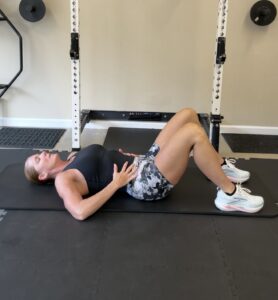
Why start here: Learning to engage your core is the foundation for many other exercises.
Lie on your back with your knees bent and feet supported.
Gently tighten your abdominal muscles as if preparing for someone to lightly tap your stomach.
Continue breathing normally while maintaining the gentle contraction.
Focus on:
- Breathing normally
- Keeping the effort controlled
- Avoiding excessive tightening or holding your breath
Make it harder: Once you can maintain your brace comfortably, add controlled arm or leg movement.
2. Supine Marching
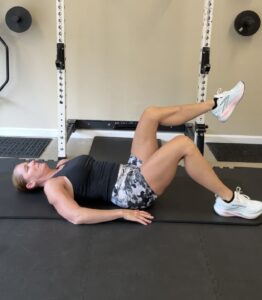
Why: Marching challenges your core to maintain control while your legs move.
Lie on your back with your knees bent.
Brace your abdominal muscles and slowly lift one foot from the floor.
Lower it with control and repeat on the other side.
Focus on:
- Keeping your pelvis controlled
- Moving slowly
- Avoiding excessive arching or flattening of your back
Progression: Increase the range of movement or progress to a dead bug.
3. Bird Dog
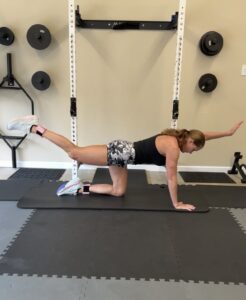
Why: Bird dog challenges your core while your opposite arm and leg move.
Start on your hands and knees.
Brace your core and slowly extend one arm and the opposite leg.
Pause briefly, then return to the starting position.
Repeat on the opposite side.
Focus on:
- Keeping your trunk steady
- Avoiding rotation
- Moving slowly rather than trying to lift your arm and leg as high as possible
Progression: Increase the hold time or add light resistance when appropriate.
4. Dead Bug
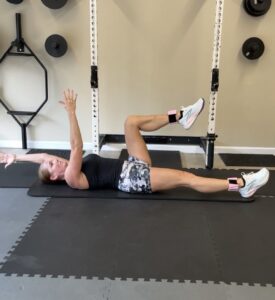
Why: Dead bugs challenge your ability to maintain trunk control while your arms and legs move.
Lie on your back with your arms up and knees bent.
Brace your core and slowly lower the opposite arm and leg toward the floor.
Return to the starting position and alternate sides.
Focus on:
- Keeping your trunk controlled
- Moving slowly
- Avoiding excessive arching of your lower back
Beginner modification: Move only your arms or only your legs.
Intermediate Core Exercises: Add Movement & Resistance
Once you can perform basic exercises with good control, you can begin challenging your core with standing movements, resistance and more complex patterns.
Remember: intermediate doesn’t mean you need to use heavy weights.
The goal is to increase the challenge while maintaining good form.
5. Standing Dumbbell March
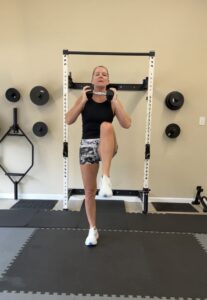
Why: This exercise challenges your core while you maintain an upright position and move your legs.
Stand tall while holding a light dumbbell in one or both hands.
Brace your abdominal muscles and slowly lift one knee at a time.
Keep your torso upright and avoid leaning from side to side.
Focus on:
- Staying tall
- Controlling your pelvis
- Keeping your abdominal brace while breathing normally
Progression: Increase the weight or duration when you can maintain good control.
6. Pallof Press
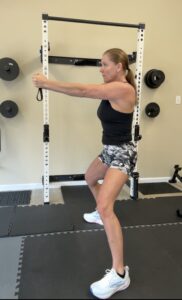
Why: The Pallof press challenges your core to resist rotation.
Stand perpendicular to a resistance band or cable.
Hold the handle close to your chest.
Brace your core and slowly press your hands away from your body.
Return your hands toward your chest with control.
Focus on:
- Keeping your torso facing forward
- Resisting the pull of the band
- Avoiding rotation
This is a great example of core strength that isn’t about creating movement—it’s about controlling movement.
7. Plank / Side Plank
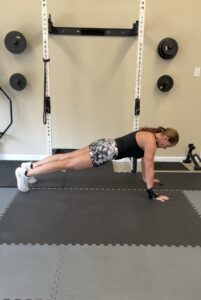
Why: Side planks / planks challenge the muscles responsible for side-to-side stability.
Start on your side with your elbow underneath your shoulder.
Lift your hips while maintaining a straight line through your body.
Hold the position while breathing normally.
Beginner modification:
Keep your knees bent and supported on the floor.
Progression:
Straighten your legs or increase your hold time as your strength improves.
8. Dumbbell Cross-Body Crunch
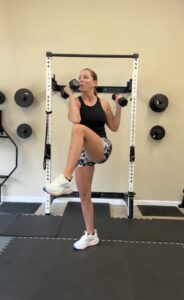
Why: This exercise adds a diagonal movement pattern and challenges the muscles of your core.
Stand tall while holding a light dumbbell.
Bring the dumbbell toward the opposite side of your body using a controlled diagonal movement.
Return to the starting position and repeat.
Focus on:
- Controlled movement
- Avoiding momentum
- Moving through a comfortable range
Remember: More movement isn’t necessarily better. Control matters.
Advanced Core Exercises: Increase the Challenge
Advanced core exercises aren’t automatically better.
They’re simply more challenging.
You should be able to perform the earlier progressions with good control before moving to exercises that add significant instability, resistance or complexity.
9. Stability Ball Core Exercises
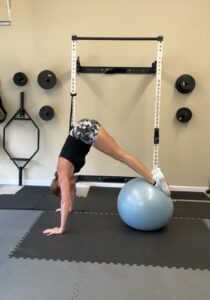
A stability ball can make familiar exercises more challenging by changing your base of support.
Depending on your experience and goals, you might use a stability ball for:
- Planks
- Dead bugs
- Bridges
- Stir-the-pot variations
- Other controlled core exercises
Why it works
Your body has to make constant small adjustments to maintain your position on the ball.
Start with a stable exercise and progress gradually rather than immediately choosing the most difficult variation.
10. Suspension Trainer Core Exercises
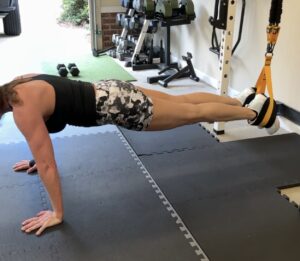
Suspension trainers, such as a sling or suspension system, can add another level of challenge by allowing your hands or feet to move while you maintain control of your trunk.
Examples include:
- Suspension plank variations
- Knee tucks
- Mountain climber variations
- Pike variations
Why it works
Your core has to work harder to stabilize your body as the suspension straps move.
These exercises aren’t necessary for building a strong core, but they can provide an appropriate challenge for someone who has already developed a solid foundation.
11. Ab Roller / Ab Carver
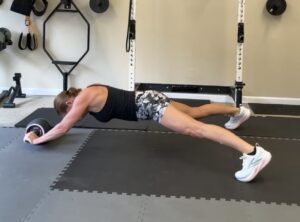
An ab roller can significantly increase the challenge of resisting extension through your spine.
Start from a position you can control and gradually increase the distance you roll.
Focus on:
- Maintaining control through your trunk
- Avoiding excessive arching of your lower back
- Using a range of motion you can control
Don’t feel like you need to roll all the way out to the floor to get a good workout.
Quality matters more than distance.
Don’t Forget Rotation and Side-to-Side Control
One of the biggest mistakes I see with core training is treating the core as if it only has one job:
Crunch forward.
Your core also helps you control movement from side to side and during rotation.
That’s important for everyday activities such as:
- Turning to reach for something
- Carrying groceries
- Getting in and out of a car
- Walking
- Changing direction
- Reaching across your body
This is why a well-rounded core routine should include stability, side-to-side control and rotation—not just flexion.
For more information on the foundations of core strength, read:
Why Core Strength Matters After 40
How Do You Know When You’re Ready to Progress?
You don’t need to pass a formal test before moving to the next level.
Instead, look for these signs:
You’re able to maintain good form.
You aren’t relying on momentum or compensating with other parts of your body.
You can breathe normally.
If you’re holding your breath through the entire exercise, the challenge may be too high.
You can control the movement.
You’re able to start and stop the movement without losing your position.
The exercise feels challenging—but manageable.
You should feel your muscles working without experiencing sharp or increasing pain.
You’re consistent with the current level.
If you’ve only performed an exercise once or twice, you probably don’t need to rush to the next progression.
Master the movement first. Then make it harder.
When Should You NOT Progress?
More challenging isn’t always better.
Stay at your current level—or modify the exercise—if you notice:
- Increasing pain
- Loss of control
- Excessive arching or twisting
- Holding your breath
- Significant shaking that you can’t control
- Using momentum to complete the movement
- Difficulty maintaining your starting position
Your body doesn’t get extra credit for choosing the hardest exercise.
A well-controlled beginner exercise can be far more beneficial than an advanced exercise performed poorly.
How Often Should You Train Your Core?
You don’t need to train your core for an hour every day.
Core muscles are already working during many strength exercises and everyday activities.
For dedicated core training, 2–3 sessions per week can be a reasonable starting point for many people, depending on the rest of their exercise routine and individual goals.
You can also incorporate core-focused movements into your regular strength workouts.
The key is consistency.
What Equipment Do You Actually Need?
You don’t need expensive equipment to build a strong core.
A good starting point can be:
- Your body weight
- An exercise mat
- A resistance band
- A light dumbbell
As you become stronger, additional tools can provide new challenges.
Equipment that can add variety:
Stability ball
Can add instability and challenge to familiar movements.
Suspension trainer
Can increase the challenge of planks and other bodyweight movements.
Ab roller / Ab Sling
Can provide a significant challenge to trunk stability.
Dumbbells
Can add resistance to standing and rotational exercises.
Makes the exercise surfacemore comfortable.
The equipment isn’t what makes the exercise effective.
The appropriate challenge, good technique and consistent training are what matter most.
Shop My PT Picks
My PT Takeaway
Your core doesn’t need to be trained with endless crunches.
A strong, functional core is about your ability to control your trunk while you move, resist unwanted movement and transfer force between your upper and lower body.
Start where you are.
Build control.
Add movement.
Then gradually increase resistance, instability or complexity as your strength improves.
You don’t need to train like an athlete to benefit from a stronger core. You just need to train at the right level for you.
Ready to Build a Stronger, More Active Body?
Core strength is just one piece of the bigger picture.
Strength, stability, mobility and recovery all work together to help you stay active and capable as you age.
If you’re ready for a structured approach rather than trying to piece together workouts on your own, explore Strong & Active After 40, my PT-designed strength, stability, mobility and recovery system.
More From Total Body Wellness
Why Core Strength Matters After 40
Learn why your core is about much more than abs and crunches.
Best Exercises for Lower Back Pain
Explore beginner-friendly exercises that may support strength and movement when dealing with low back discomfort.
Why Strength Training Matters After 40
Learn why maintaining strength becomes increasingly important as we age.
Mobility vs. Flexibility: What’s the Difference?
Learn how mobility and flexibility differ and why both matter for healthy movement.
This post may contain affiliate links. I may earn a commission if you purchase through links on this page, at no additional cost to you. I only recommend products I personally use, trust, or believe may benefit my readers.
Pingback: Why Core Strength Matters After 40: More Than Just Abs – Total Body Wellness